What 'Healthy' on a Food Package Now Means (FDA's Updated Claim)
Understand FDA's updated healthy claim, its food-group and nutrient criteria, the transition dates, and what to check on a food label.
Key takeaways
- The updated claim generally combines qualifying food-group amounts with limits on added sugars, sodium, and saturated fat (FDA).
- Companies could start using the new criteria on April 28, 2025, and must follow them by February 25, 2028, if they use the claim (FDA).
- Using the claim is voluntary, so its absence does not tell you that a food failed the criteria (FDA).
- Use the claim to shortlist foods, then check ingredients, serving size, and Nutrition Facts.
Use ‘healthy’ on a package as a reason to look closer, then compare the ingredients and Nutrition Facts. FDA’s updated claim generally requires qualifying food-group amounts alongside limits on added sugars, sodium, and saturated fat (FDA).
The transition matters, too. A familiar package may still be using the earlier criteria while manufacturers move toward the compliance deadline.
When the updated claim takes effect
FDA announced the final rule on December 19, 2024 (FDA). The original effective date was February 25, 2025, but FDA postponed it to April 28, 2025 (FDA).
Companies choosing to use the claim could apply the new standards starting April 28, 2025, and need to follow the updated definition by February 25, 2028 (FDA).
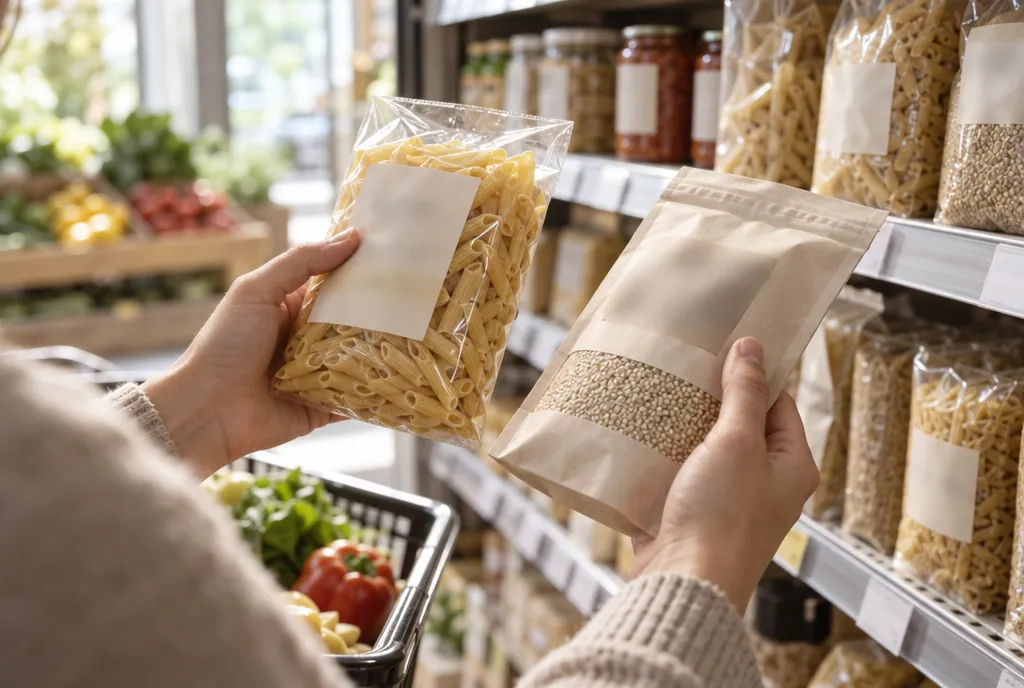
If you are comparing familiar foods, turn both packages around. You can assess their listed nutrients without knowing when either manufacturer changed its label.
What changed in the definition?
The earlier definition focused on individual nutrients, including limits on total fat, saturated fat, cholesterol, and sodium, plus requirements for certain beneficial nutrients (FDA). The updated approach adds food-group requirements and includes added sugars among the nutrients limited (FDA).
For most covered products, the question is whether the food supplies a qualifying amount from the relevant food group and meets its nutrient limits (FDA). Meeting a sodium limit alone does not establish that a cereal or yogurt qualifies.
FDA identifies nuts, seeds, olive oil, higher-fat fish such as salmon, eggs, and water as examples that can qualify under the updated definition (FDA). Its examples that no longer qualify include fortified white bread, highly sweetened yogurt, and highly sweetened cereal (FDA).
Those examples are about plain versions of each food; a salted or sweetened version can fall outside the limits, so still check the label.
FDA’s criteria by food group
The table reproduces the values in FDA’s food-group summary, presented per Reference Amount Customarily Consumed, or RACC (FDA). A RACC underlies serving-size determination; it is not the weight of whatever portion you happen to serve.
Food-group equivalents describe the required contribution from a food group, rather than necessarily the total weight of the packaged product (FDA). DV means Daily Value; g means grams, mg means milligrams, and oz means ounces.
| Food category | Food-group minimum | Added sugars limit | Sodium limit | Saturated fat limit |
|---|---|---|---|---|
| Grains product | 3/4 oz whole-grain equivalent | 10% DV (5 g) | 10% DV (230 mg) | 5% DV (1 g) |
| Dairy product | 2/3 cup equivalent | 5% DV (2.5 g) | 10% DV (230 mg) | 10% DV (2 g) |
| Vegetable product | 1/2 cup equivalent | 2% DV (1 g) | 10% DV (230 mg) | 5% DV (1 g) |
| Fruit product | 1/2 cup equivalent | 2% DV (1 g) | 10% DV (230 mg) | 5% DV (1 g) |
| Game meat | 1 1/2 oz equivalent | 2% DV (1 g) | 10% DV (230 mg) | 10% DV (2 g) |
| Seafood | 1 oz equivalent | 2% DV (1 g) | 10% DV (230 mg) | 5% DV (1 g), excluding inherent saturated fat |
| Egg | 1 egg | 2% DV (1 g) | 10% DV (230 mg) | 10% DV (2 g) |
| Beans, peas, and lentils | 1 oz equivalent | 2% DV (1 g) | 10% DV (230 mg) | 5% DV (1 g) |
| Nuts, seeds, and soy products | 1 oz equivalent | 2% DV (1 g) | 10% DV (230 mg) | 5% DV (1 g), excluding inherent saturated fat |
| Pure oil | N/A | 0% DV | 0% DV | 20% of total fat |
| Oil-based spreads | N/A | 0% DV | 10% DV (230 mg) | 20% of total fat |
| Oil-based dressing | N/A | 2% DV (1 g) | 10% DV (230 mg) | 20% of total fat |
FDA labels the pure-oil category ‘100% Oil’; oil-based dressings must contain at least 30% oil (FDA). For the marked protein categories, saturated fat inherent in seafood, nuts, seeds, and soy products is excluded from the saturated-fat limit (FDA).
FDA also says qualifying vegetables, fruits, whole grains, fat-free and low-fat dairy, lean game meat, seafood, eggs, beans, peas, lentils, nuts, and seeds automatically qualify when they have no added ingredients except water (FDA).
Mixed products, main dishes, and meals have separate criteria; do not apply an individual-food row to a complete frozen dinner (FDA). Use this table to understand the structure of the claim, rather than trying to certify a manufacturer’s recipe yourself.
What the claim does and does not tell you
FDA says the updated criteria identify foods that help consumers build a healthy eating pattern (FDA). It is a useful starting signal, not a complete shopping decision.
The claim is voluntary, so a missing claim does not show that a product failed the criteria (FDA). Compare a plain food without prominent marketing just as carefully as one with a large front-label statement.
You still need to decide whether the food suits your meals, budget, preferences, and personal needs.
What FDA currently says about a symbol
FDA’s claim page says the agency continues to explore and develop a symbol that manufacturers could use to show a food meets the definition (FDA). It does not present a finished symbol there for shoppers to recognize.
FDA’s 2026 priorities also describe advancing potential symbol guidance and assessing whether the claim needs changes to align with the 2025–2030 Dietary Guidelines (FDA). Those are stated work plans, not evidence that revised criteria or a symbol have already been adopted.
For now, read the wording and nutrition information. Do not treat a manufacturer’s decorative graphic as proof of an FDA designation.
Keep reading the label after spotting the claim
Start with serving size: FDA explains that the nutrient amounts on Nutrition Facts relate to the stated serving, and that serving size is not a recommendation for how much to eat (FDA). Compare similar portions before deciding between products.
For general nutrient comparisons, FDA considers 5% DV or less per serving low and 20% DV or more high (FDA). These are label-reading shortcuts, not substitutes for the category-specific claim criteria.
Use how to read a nutrition label for a fuller walkthrough. The added sugars guide and sodium claims guide explain wording that may appear nearby.
Breakfast foods
Compare the cereal or yogurt you normally buy with an alternative. Check ingredients, serving size, added sugars, sodium, and saturated fat before deciding which fits your breakfast.
For cereal and bread, our whole-grain labels guide helps you identify the actual grain ingredients. Add fruit or other foods according to the breakfast you want to make.
A prepared meal
Read the label for the portion you will eat, then consider anything you plan to add, such as dressing or sauce. Do not judge the meal only by the most prominent words on the box.
Use building a balanced plate when deciding what to serve alongside it. Choose additions that suit your appetite and existing eating plan.
Your shopping checklist
Use this checklist on foods you buy regularly. Keep a photo or short note about the option you prefer so you can find it again.
- Treat ‘healthy’ as a starting point for checking the package.
- Remember that manufacturers are still within the transition period.
- Read ingredients to understand what the food contains.
- Check serving size against the portion you plan to eat.
- Compare added sugars, sodium, and saturated fat.
- Check relevant allergens and personal dietary instructions.
- Consider comparable foods that do not display the claim.
- Choose something that fits a meal you will actually prepare or eat.
Frequently asked questions
Does every healthy label already follow the updated definition?
Do not assume that during the transition. FDA says companies could use the updated criteria starting April 28, 2025, and need to follow them by February 25, 2028 (FDA). Keep reading the Nutrition Facts and ingredients rather than relying on the word alone.
Is a food without the claim an unhealthy choice?
No such conclusion follows from the missing claim. FDA makes its use voluntary, so a manufacturer can choose not to display it (FDA). Compare the food itself, its ingredients, and its nutrient information with the alternatives you would actually buy.
Does healthy mean no added sugar or sodium?
No. FDA sets category-specific limits rather than requiring every qualifying food to contain none of these nutrients (FDA). Read the relevant lines on Nutrition Facts, especially if you have personal instructions about limiting sodium or added sugars.
Has FDA launched a standard healthy symbol?
The FDA pages reviewed for this guide describe continued development of a potential symbol, rather than an announced finished symbol for shoppers to use (FDA). Do not assume that a decorative leaf, heart, or badge on a package is that FDA symbol.
Sources
- Use of the 'Healthy' Claim on Food Labeling — FDA
- FDA Finalizes Updated 'Healthy' Nutrient Content Claim — FDA
- The Updated Healthy Claim and What It Means for You — FDA
- A Fresh Take on What 'Healthy' Means on Food Packages — FDA
- Human Foods Program 2026 Priority Deliverables — FDA
- How to Understand and Use the Nutrition Facts Label — FDA