How to Organize Your Fridge and Freezer for Food Safety
Set your fridge to 40 °F or below and your freezer to 0 °F, then store raw meat, eggs, leftovers and frozen food where they stay safe. Plus what to do in an outage.
Key takeaways
- Keep an appliance thermometer in both sections and make sure the refrigerator temperature is at 40 °F or below and the freezer is at 0 °F or below.
- FSIS says a fridge should be 40 °F or below throughout the unit, so that any place is safe for storage of any food. What matters most is sealing or wrapping raw meat, poultry and seafood so the juices can't reach other foods.
- Don't store perishable foods in the door, where the temperature swings more, and keep eggs in their carton on a shelf.
- Food stored constantly at 0 °F will always be safe; only the quality suffers with long storage.
- In a power outage, the refrigerator will keep food safe for up to 4 hours and a full freezer will hold the temperature for approximately 48 hours (24 hours if it is half full) if you keep the doors closed.
Start with the dial, not the shelves. If your fridge isn’t cold enough, no layout will keep food safe, so check the temperature first and then give raw meat, eggs, leftovers and frozen food a set place.
Set the temperatures first
The two numbers to know: CDC says to keep your refrigerator at 40 °F or below and your freezer at 0 °F or below. FDA gives the same targets, adding that appliance thermometers are the best way of knowing these temperatures and are generally inexpensive.
Why 40 °F? FSIS explains that bacteria grow most rapidly between 40 and 140 °F, the “Danger Zone,” some doubling in number in as little as 20 minutes. A built-in display is a start, but FSIS says that if your fridge doesn’t have one, you should keep an appliance thermometer in the refrigerator to monitor the temperature.
Where you put the thermometer matters. FDA suggests you place one in your refrigerator and one in your freezer, in the front in an easy-to-read location, and check the temperature regularly, at least once a week. If you adjust the dial, FSIS notes that an adjustment period is often required, so recheck later rather than turning it again right away.
Where things go in the fridge
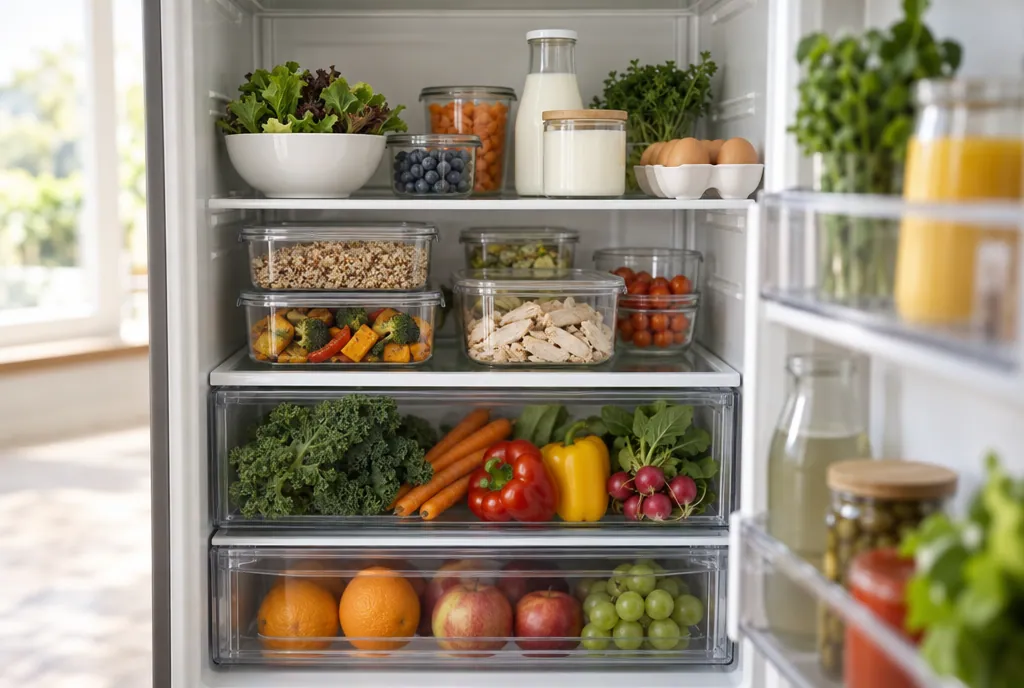
Here’s the reassuring part. FSIS says the temperature should be 40 °F or below throughout the unit, so that any place is safe for storage of any food. Organizing is mostly about stopping drips, avoiding the warmer door and making older food easy to spot.
The zones below use the wording from the FSIS Refrigeration and Food Safety page:
| Zone | What to keep there | What FSIS says |
|---|---|---|
| Shelves | Covered leftovers, eggs in their carton | Eggs should be stored in the carton on a shelf; cover foods to retain moisture and prevent them from picking up odors |
| Anywhere raw meat goes | Raw meat, poultry and seafood | Should be in a sealed container or wrapped securely to prevent raw juices from contaminating other foods |
| Crisper drawers | Fruits and vegetables | Sealed crisper drawers provide an optimal storage environment for fruits and vegetables |
| Meat drawer (if you have one) | Meats and cheeses | An adjustable temperature meat drawer maximizes the storage time of meats and cheeses |
| Door | Nothing perishable | Don’t store perishable foods in the door; door bin temperatures fluctuate more than the cabinet |
Raw meat: stop the drips
CDC’s advice for storing food is to keep raw or marinating meat, poultry, seafood, and eggs separate from all other foods and to store raw meat, poultry and seafood in sealed containers or wrapped securely so juices don’t leak. A lidded container or a rimmed dish under the package does the job on any shelf. If you marinate, FDA says to marinate food in the refrigerator, not on the counter.
Give air room to move
FDA warns against cramming: don’t crowd the refrigerator or freezer so tightly that air can’t circulate. Hot food doesn’t have to cool on the counter first. FSIS says hot food can be placed directly in the refrigerator, and a large pot of soup or stew should be divided into small portions in shallow containers. Our leftovers guide covers cooling and reheating in more detail.
Keep it clean and rotate what you have
Spills are a food safety issue, not just a mess. FDA says cleaning regularly and wiping spills right away helps reduce the growth of Listeria bacteria and prevents drips from thawing meat from spreading bacteria to other foods. FSIS says to wipe up spills immediately, clean surfaces thoroughly with hot, soapy water, then rinse.
Pick one day a week for a quick sweep. FSIS suggests that once a week you throw out perishable foods that should no longer be eaten, and gives a rule of thumb of 4 days for cooked leftovers and 1 to 2 days for raw poultry and ground meats. When you put new groceries away, slide older items to the front so they get used first. To make sense of the dates printed on packages, see our guide to food date labels.
Organize the freezer
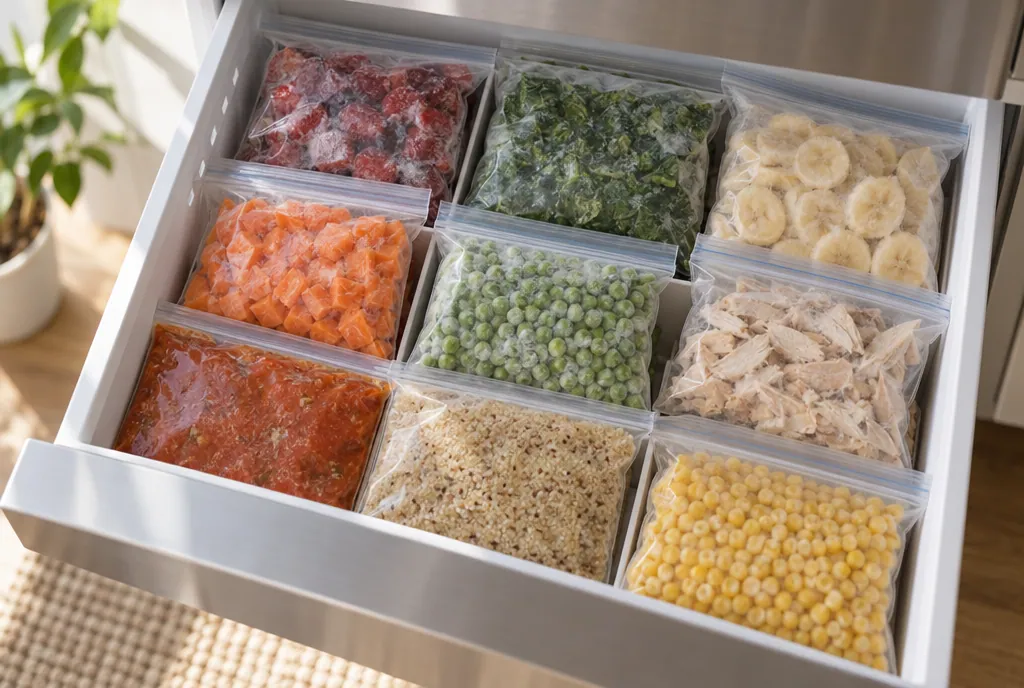
At the right temperature, the freezer keeps food safe for a long time. FSIS says food stored constantly at 0 °F will always be safe and that recommended freezer storage times are for quality only. That’s why labeling helps: write what’s in each package and the date it went in, so you can use older food while it still tastes good.
A few FSIS points from its Freezing and Food Safety page shape how to pack the freezer:
- Wrap well. Freezing meat or poultry in its original packaging is safe, but that wrap is permeable to air. For prolonged storage, overwrap it.
- Freeze flat first. Never stack packages to be frozen. Spread them out in one layer and stack them only after they’re frozen solid.
- Use the right freezer for long storage. If the freezer compartment in your fridge can’t hold zero degrees or gets opened often, use it for short-term storage. FSIS says to use a free-standing freezer set at 0 °F or below for long-term storage.
Thawing is part of the plan too. FSIS lists three safe ways to thaw food: in the refrigerator, in cold water, or in the microwave. Our guides to thawing food safely and freezer-friendly meals go further.
When the power goes out
The main rule is simple: keep the doors shut. FSIS says to keep refrigerator and freezer doors closed, and that in freezers, food in the front, in the door, or in small, thin packages will defrost faster than large, thick items or food in the back or bottom of the unit.
Fridge
FSIS says the refrigerator will keep food safe for up to 4 hours. If the power stays off longer, move food to a cooler with ice or frozen gel packs, with enough ice to keep it at 40 °F or below.
Afterward, FSIS says to discard perishables such as meat, poultry, fish, eggs, leftovers, milk and soft cheeses if your refrigerator has been without power for more than 4 hours.
Freezer
FSIS says a full freezer will hold the temperature for approximately 48 hours (24 hours if it is half full). To prepare, FSIS suggests you keep the freezer full and fill empty spaces with frozen plastic jugs of water, bags of ice, or gel packs.
When the power returns, FSIS says frozen foods that have thawed but still contain ice crystals, or that have remained at 40 °F or below, may be safely refrozen, though quality may suffer.
FSIS is blunt about the rest: never taste food to determine its safety, and when in doubt, throw it out. An appliance thermometer you already keep in each section is what lets you make that call with confidence. More guides like this are in the Food Safety at Home hub.
Fridge and freezer organization checklist
- Appliance thermometer in the fridge and in the freezer, checked at least once a week
- Fridge at 40 °F or below, freezer at 0 °F or below
- Raw meat, poultry and seafood sealed or wrapped, away from ready-to-eat food
- Eggs in their carton on a shelf, nothing perishable in the door
- Leftovers covered and in shallow containers
- Spills wiped up right away; a weekly clear-out of food past its time
- Freezer packages overwrapped, labeled with the contents and date, older ones in front
- Room left for air to circulate
Frequently asked questions
How do I check my fridge temperature accurately?
FSIS says to put the thermometer in a glass of water and place it in the middle of the refrigerator, then wait 5 to 8 hours. If the reading is not 38 to 40 °F, adjust the temperature control and check again after another 5 to 8 hours. For the freezer, place the thermometer between frozen packages; FSIS says to adjust if it isn't 0 to 2 °F.
Can I keep milk in the fridge door?
It's better on a shelf. FSIS says don't store perishable foods in the door because door bin temperatures fluctuate more than the main cabinet. Milk is on the FSIS list of foods to discard if your refrigerator has been without power for more than 4 hours, so treat it as perishable.
Is freezer-burned food safe to eat?
Yes. FSIS says freezer burn does not make food unsafe, merely dry in spots. It shows up as grayish-brown leathery spots where air touched the food. Cut those parts away before or after cooking. Heavily freezer-burned food may need to be thrown out for quality reasons, not safety.
How long do leftovers keep in the fridge and freezer?
FSIS says leftovers can be kept in the refrigerator for 3 to 4 days or frozen for 3 to 4 months. Frozen leftovers stay safe indefinitely, but they can lose moisture and flavor the longer they sit, so the months are about quality.
Sources
- Refrigeration & Food Safety — USDA Food Safety and Inspection Service
- Freezing and Food Safety — USDA Food Safety and Inspection Service
- Appliance Thermometers — USDA Food Safety and Inspection Service
- Keep Your Food Safe During Emergencies: Power Outages, Floods & Fires — USDA Food Safety and Inspection Service
- Leftovers and Food Safety — USDA Food Safety and Inspection Service
- Are You Storing Food Safely? — U.S. Food and Drug Administration
- Preventing Food Poisoning — CDC