How to Make a Weekly Meal Plan (Step by Step, With a Template)
Build a weekly meal plan in five steps: check your kitchen, pick meals by food group, plan leftovers, write the grocery list and schedule a prep session.
Key takeaways
- Plan meals around the food groups: the 2025–2030 Dietary Guidelines give serving goals of 3 vegetable and 2 fruit servings a day in a 2,000-calorie pattern.
- Cook more than once a week: FSIS says leftovers can be kept in the refrigerator for 3 to 4 days or frozen for 3 to 4 months.
- Plan the cooling step too: leftovers must be refrigerated within 2 hours of cooking.
- Check what you already own before you write the grocery list, and build the list from the plan, not the other way around.
- A plan only works if it fits your week. Start with three or four dinners and leave a night open.
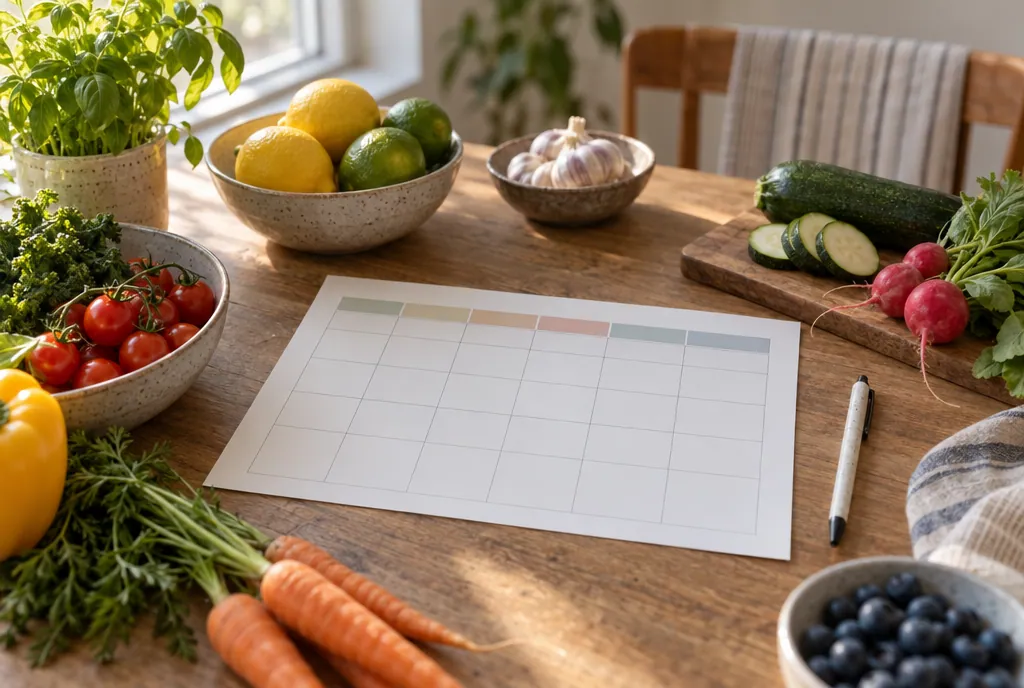
A weekly meal plan is a short list of what you will eat, which night you will cook and what you need to buy. Sit down with it once a week and you can answer “what’s for dinner?” before you are tired and hungry. Use the template below and the five steps that follow.
Copy the grid onto paper, a whiteboard or a notes app. Fill in dinners first, then lunches, then breakfast and snacks. Mark your cook days and your leftovers days before you add a single recipe.
Step 1: Check what you already have
Open the fridge, freezer and pantry before you decide anything. Meals that use up what is already there save money and cut down on food you throw away.
- Pull out anything that needs eating soon, such as vegetables, yogurt or an open can of beans, and slot it into the first few days.
- Note what is in the freezer. A frozen portion of soup is a ready-made dinner.
- Look at the pantry staples: grains, canned beans, canned tomatoes, oats, nut butter. These are your base ingredients.
- Look at your calendar. Mark late meetings, practices and nights out so you do not plan a cooking project for them.
Step 2: Pick meals by food group
Instead of picking recipes first, pick the food groups each meal needs, then fill in the dish. The 2025–2030 Dietary Guidelines for Americans say to prioritize protein foods at every meal and to eat vegetables and fruits throughout the day. The table below uses the serving goals from the same Dietary Guidelines document. The vegetable, fruit and dairy goals are for a 2,000-calorie pattern, and the guidelines say to adjust all of them to your own calorie needs.
| Food group | Dietary Guidelines goal | Where it fits in your plan |
|---|---|---|
| Protein foods | Prioritized at every meal | Eggs at breakfast, beans or chicken at lunch, fish or tofu at dinner |
| Vegetables | 3 servings per day | A side or base at lunch and dinner, plus a vegetable snack |
| Fruits | 2 servings per day | Breakfast topping, snack, or dessert |
| Whole grains | 2 to 4 servings per day | Oats, brown rice, whole-wheat bread or pasta |
| Dairy | 3 servings per day | Yogurt, milk or cheese at breakfast or as a snack |
The same Dietary Guidelines document says that when you eat dairy, you should include full-fat dairy with no added sugars, and that one meal should contain no more than 10 grams of added sugars. Plain yogurt with fruit fits that better than a flavored cup.
A practical way to fill the grid: choose one protein, one vegetable and one whole grain for each dinner, then reuse parts of it at lunch. Our guide to building a balanced plate shows how the groups look on a plate.
Pick your pattern
Cook nightly
Plan a simple dinner for each night and one extra portion for tomorrow’s lunch. Choose recipes that take 30 minutes or less. Keep one “no-recipe” meal, such as eggs and toast with a side of fruit, for the night the plan falls apart.
Batch cook
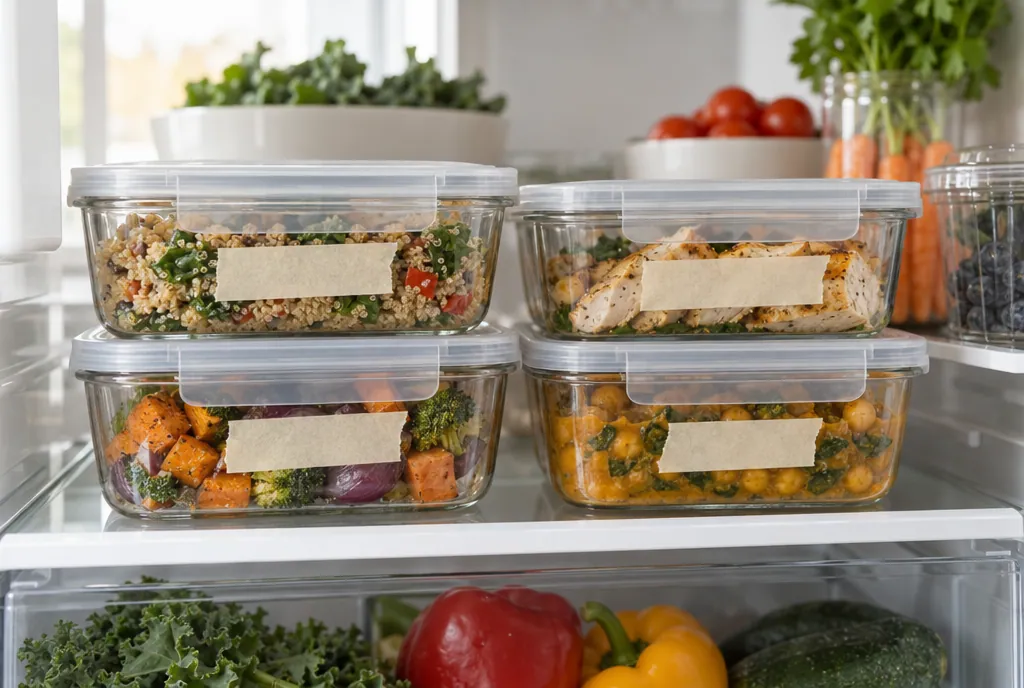
Cook on one or two days and assemble the rest. Make a pot of grains, a tray of roasted vegetables and one or two proteins, then mix them into bowls, wraps and salads. Our meal prep basics guide covers the order of a prep session.
Step 3: Plan leftovers on purpose
Leftovers are the easiest way to shrink your cooking time, but they have a clock on them. The template above is built around that clock.
FSIS says leftovers can be kept in the refrigerator for 3 to 4 days or frozen for 3 to 4 months. That is why the sample week has two cook days (Sunday and Wednesday) instead of one. Food cooked on Sunday is eaten Monday and Tuesday, and the Wednesday cook day restocks the second half of the week.
Plan for the cooling step as well:
- Leftovers must be refrigerated within 2 hours of cooking, so do not leave a pot on the stove while you eat.
- FSIS recommends that you divide large amounts of food into shallow containers so food cools quickly.
- When you reheat, FSIS says to make sure leftovers reach 165°F as measured with a food thermometer.
- If a meal will land after day 4, freeze that portion on the day you cook it.
Step 4: Build the grocery list
Write the list from the finished plan, one section at a time, and cross off whatever you already have from Step 1.
- List the ingredients for each meal in the grid.
- Combine duplicates, such as a vegetable that appears in three dishes.
- Subtract what you have.
- Sort what is left by store section: produce, protein, dairy, grains and canned goods, frozen.
- Add a short “flex” line for one or two items you will decide on at the store, such as whatever vegetable is on sale.
Read the label when you pick packaged items. Our guide to a healthy grocery list on a budget has ideas for keeping costs down.
Step 5: Schedule a prep session
Put the prep session on your calendar like any other appointment, on a day you are home. How long to block out depends on how much you cook, so time your first session and adjust from there.
Plan for one
Cook two or three recipes in small batches and freeze single portions. A cook day every 3 to 4 days keeps the fridge portion within the leftovers window, so you rarely need to throw anything out. See healthy meal planning for one for more ideas.
Plan for two
Double a recipe and eat it twice. Two people usually get through a pot of soup or a tray of roasted vegetables inside the leftovers window. Take turns picking the week’s meals so you both buy in.
Plan for a family
Plan the same base for everyone and let people add their own toppings, like a taco or grain-bowl night. Ask each person to choose one meal for the week. Use the open night for leftovers. Our guide to family meal planning on a budget goes deeper.
Weekly planning checklist
- Check the fridge, freezer and pantry
- Look at your calendar and mark busy nights
- Choose a protein, a vegetable and a whole grain for each dinner
- Fill in lunches by reusing dinner parts
- Add breakfasts and snacks
- Mark your cook days and leftovers days
- Build the grocery list and subtract what you have
- Put the prep session on your calendar
- Label containers with the date you cooked them
For more ideas, browse everything in Meal Planning & Prep. This guide is general information; see our medical disclaimer.
Frequently asked questions
How many days ahead should I plan?
Most people do well with a week, but you can plan fewer nights. Because FSIS says refrigerated leftovers keep for 3 to 4 days, a plan that cooks on two days covers a full week more easily than one big cook.
Do I need to plan snacks?
It helps to pencil them in, since snacks are where an unplanned week often drifts. Use the same food groups as meals: fruit, vegetables, dairy or protein foods. The Dietary Guidelines set goals of 2 fruit and 3 vegetable servings a day for a 2,000-calorie pattern, and snacks can count toward them.
What if I do not follow the plan?
Treat the plan as a menu of options, not a contract. Swap days, move a meal to the freezer, or use an open night for whatever needs eating. If you freeze food, FSIS says leftovers can be frozen for 3 to 4 months.
How do I plan if someone has a food allergy or a health condition?
Check with their doctor or a registered dietitian first, then build the plan around what they advise. Read ingredient labels each time you shop. This guide is general information, not individual advice.